
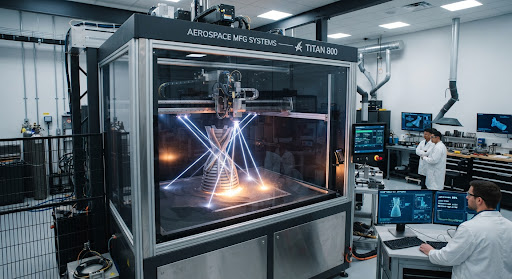
Additive manufacturing spent its first decade in aerospace confined to rapid prototyping and non-structural tooling. That era is over. Laser powder bed fusion of titanium alloys — principally Ti-6Al-4V — now produces flight-ready titanium parts carrying primary load paths: structural brackets, hydraulic manifolds, heat-exchanger cores, and even rocket engine nozzle components. What began as a prototyping convenience has become a certified production process, and 3D printing now sits alongside forging and machining as a first-class option in aerospace design reviews.
The shift did not happen because printers got marginally better. It happened because the industry solved, piece by piece, the qualification problem that separates a good-looking part from a certifiable one.
Why Titanium, and Why Now
Titanium’s strength-to-weight ratio has always made it attractive for airframes and engines, but its poor machinability and punishing buy-to-fly ratio made it expensive to use except where absolutely necessary. Machining a complex titanium bracket from billet can turn the overwhelming majority of the raw material into chips, and titanium chips are slow to produce, hard on cutting tools, and costly to recycle back to aerospace grade.
Laser powder bed fusion inverts that economics. The part is built layer by layer from powder, consuming close to only the material the final geometry actually requires, with unfused powder largely recoverable under a controlled reuse protocol. For a metal whose raw stock is expensive and whose machining is slow, that inversion changes which designs are affordable at all.
Design Freedom as the Real Dividend
The design freedom additive unlocks is arguably more significant than the material savings. Internal lattice structures place material only along load paths, generative design software produces organic topology no cutter could reach, and assemblies that previously required a dozen fastened components can be consolidated into a single printed part with no joints to inspect or fasteners to fatigue. Across the production programs DCM Aeronautique has reviewed, part consolidation is consistently cited as the strongest business case — every deleted fastener removes purchasing, inventory, assembly labor, and a potential failure point at once.
The same capability is enabling components that could not exist otherwise, such as conformal-cooled combustor hardware and the finely atomized fuel injectors discussed in our look at hypersonic propulsion systems, where internal passage geometry directly sets performance.
Qualifying the Process, Not Just the Part
The hardest part of additive aerospace adoption has never been the printer — it has been process qualification. Mechanical properties in additive titanium depend heavily on build orientation, laser scan strategy, powder condition, and post-build thermal treatment, so certification bodies require statistically validated process control rather than simple part-by-part inspection. A qualified process is effectively frozen: machine, parameter set, powder specification, and build layout are locked, and any change reopens qualification work.
Powder, Porosity, and Post-Processing
In practice that means obsessive control of the unglamorous steps. Powder is sampled and tracked across reuse cycles; builds carry witness coupons that are destructively tested alongside the parts they accompanied; and hot isostatic pressing is typically applied to close internal porosity before mating surfaces are finish-machined and the part goes through non-destructive inspection. Surface finish remains additive’s persistent weakness, which is why critical interfaces are still cut conventionally — a reminder that additive complements rather than replaces the capabilities described in our piece on multi-axis machining for turbine components.
Where Flight-Ready Titanium Printing Goes Next
That qualification burden explains why additive titanium has moved fastest in lower-volume, higher-value applications — rocket engine hardware, satellite structures, specialty brackets — where the economics favor design freedom over sheer throughput. For high-volume airframe structure, subtractive manufacturing still wins on production-line speed and a mature statistical history that certifiers trust by default.
The trajectory, though, is steady. Multi-laser machines are raising build rates, in-situ monitoring is beginning to give certifiers layer-by-layer evidence rather than post-build sampling alone, and design organizations are training a generation of engineers who think in load paths rather than stock shapes. On the order of a decade from now, the interesting question in a design review will not be whether a titanium part is printed — it will be why one was not.