
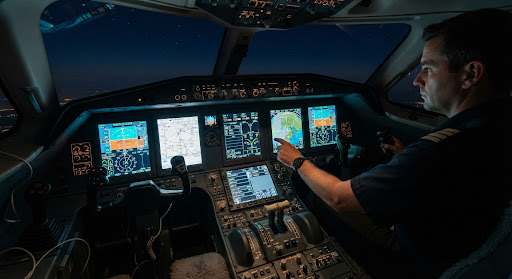
Modern glass cockpits already synthesize hundreds of sensor channels into a handful of primary displays, but the next generation of flight deck software is doing something categorically different: it is beginning to interpret the data rather than merely present it. Machine learning algorithms are arriving in the cockpit not as a robot pilot but as a certified inference layer running alongside traditional deterministic avionics — a decision-support tool assisting pilots with complex sensor data during the phases of flight where workload peaks, and one that is now appearing in flight-test programs across the industry.
The distinction matters, because public conversation about AI in aviation tends to leap straight to autonomy. What is actually being engineered is far narrower — and, in the near term, far more useful.
Anomaly Detection, Not Autopilot
The near-term application is deliberately constrained: pattern recognition across fused sensor data to flag developing anomalies before they cross a hard alerting threshold. Representative cases from current test programs include:
- An engine vibration signature drifting outside its historical envelope while still inside published limits
- An icing condition building faster than the anti-ice system’s baseline model predicts
- A hydraulic pressure trace that reads technically green but is trending in a way that has historically preceded a fault
Traditional alerting logic is, by design, reactive — a caution fires only when a single parameter breaches a fixed limit. A model trained on millions of flight hours of nominal and off-nominal sensor traces can recognize a developing trend while every individual gauge still reads normal. DCM Aeronautique’s avionics correspondents have reviewed flight-test data showing meaningful lead-time improvements for several classes of mechanical degradation. In effect, the airborne inference layer is the real-time counterpart to the predictive digital twin models operators already run against engine telemetry on the ground — the same statistical insight, delivered to the crew while it can still shape the flight rather than the maintenance plan.
Machine Learning in the Cockpit Meets DO-178C
Getting a non-deterministic model into a certified flight-critical system is the hard part, and it is worth being precise about why. The DO-178C framework that governs avionics software assumes traceability: every behavior maps back to a written requirement that can be verified through testing. A trained neural network does not decompose that way — its behavior is statistical, shaped by training data rather than enumerated requirements, and its edge cases cannot be exhaustively demonstrated in advance.
Regulators have responded by drawing a firm line. Machine learning inference is currently certifiable only for advisory-level information: the model can highlight a concern, annotate a trend, or suggest a checklist, but the aircraft’s core flight control laws and its formal caution-and-warning logic remain entirely conventional and deterministic. Emerging approaches such as runtime assurance — wrapping the model in a deterministic monitor that bounds what it is allowed to display — may gradually widen that envelope, but the advisory ceiling is likely to persist for years. Reasonably so.
Reducing Workload Where It Actually Peaks
Even confined to an advisory role, the operational value is concentrated in the highest-tempo phases of flight: approach in marginal weather, go-around decision points, engine-out procedures. These are exactly the moments when a crew has the least spare capacity to scan trend data manually, and when an earlier, calmer heads-up changes the quality of the decision that follows.
The human-factors work is as demanding as the algorithmic work. An advisory system that over-alerts trains crews to ignore it; one that surfaces insight ambiguously adds workload instead of removing it. Test programs are accordingly spending as much effort on display philosophy — what to show, when, and how confidently — as on model accuracy, because trust calibration between pilot and machine is what determines whether the lead time these systems buy is actually used.
The trajectory from here is steady rather than sudden. Expect advisory-level machine learning to spread quietly through flight decks over the next several certification cycles — first in trend monitoring, then in context-aware checklist and diagnosis support — while the deterministic core of the aircraft stays exactly where regulators insist it remain. The cockpit is not being automated so much as it is being given a longer view ahead of the aircraft, and that is a change pilots are likely to welcome.