
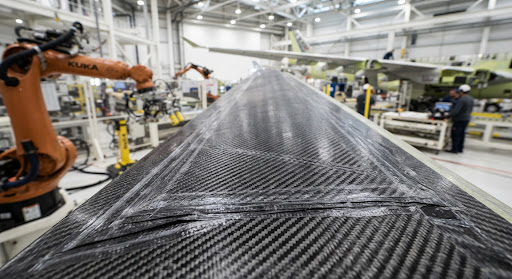
Carbon fiber reinforced polymer transformed airframe design over the last thirty years, but its manufacturing footprint — energy-intensive fiber production, non-recyclable thermoset resin systems, and end-of-life landfill disposal — has become a genuine liability as regulators tighten lifecycle emissions accounting. Bio-composite integration is emerging as a credible response for sustainable airframes: high-strength flax-based laminates that reduce the carbon footprint of aircraft manufacturing in the many applications, from cabin interiors to secondary structure, that do not demand carbon fiber’s absolute strength-to-weight ceiling.
The framing matters. This is not a story about replacing carbon fiber; it is a story about deploying it more selectively.
Where Bio-Composite Integration Actually Competes
Natural fiber composites will not displace carbon fiber from primary wing spars or fuselage skins any time soon — their specific strength typically lands at roughly 60 to 70 percent of comparable carbon layups, and primary structure is precisely where that gap is unaffordable. But an aircraft carries a substantial mass of composite that is not primary structure at all: cabin sidewall and ceiling panels, stowage bins, seat shells, galley furniture, partition walls, and assorted secondary brackets and fairings. These are exactly the components where flax, hemp, and basalt-fiber hybrid laminates are now qualifying against aerospace flammability and smoke-toxicity standards.
For these parts, stiffness per unit cost and per unit embodied energy matters more than ultimate strength, and the bio-composite proposition becomes straightforwardly competitive. The laminates also process on largely conventional equipment — press forming and resin infusion adapt with modest parameter changes — though machining them is its own discipline: natural-fiber layups shear even less predictably than carbon, reinforcing the case made in our look at calibration protocols for composite-specific drilling that generic “composite settings” are a fiction.
The Manufacturing and Lifecycle Case
The sustainability argument rests on two legs. The first is production energy: flax fiber is grown and mechanically processed, consuming a small fraction of the energy demanded by carbon fiber’s high-temperature oxidation and carbonization furnaces. The second is end of life. Several resin systems developed for this application are now bio-derived and partially recyclable through mechanical reprocessing — ground and reincorporated into new molded parts — which represents a genuine first for aerospace composite waste streams that have historically had no destination but landfill.
There are honest caveats. Natural fibers absorb moisture, so panel designs rely on careful resin encapsulation and, in some cases, hybrid layups with synthetic outer plies to stabilize performance across cabin humidity cycles. Fiber properties also vary with growing conditions in a way spooled carbon tow does not, which pushes qualification effort toward statistical batch control of the raw fiber supply — a solvable problem, but one the aerospace-grade supply chain is still maturing through.
Certification Pathway and Cabin-Level Benefits
DCM Aeronautique’s materials desk has reviewed test data showing natural-fiber interior panels meeting FAR 25.853 flammability requirements without the halogenated fire retardants that complicate disposal of conventional interior composites — a compounding benefit, since it cleans up both the fire-safety chemistry and the end-of-life story in one move.
Two secondary advantages are worth flagging for cabin engineers:
- Acoustic damping: the irregular internal structure of flax fiber attenuates cabin noise more effectively than uniform carbon weaves at equivalent panel thickness, a measurable comfort gain at no added mass.
- Benign failure behavior: natural-fiber laminates tend to splinter less sharply than carbon on impact, a modest but real handling and crashworthiness consideration for interior panels.
Adoption will be incremental rather than sweeping, and that is the correct expectation to set. The realistic sequence begins with regional and business aviation interiors within the next several certification cycles — programs with smaller part counts and faster cabin refresh timelines — followed by mainline retrofit interiors, and only later any flirtation with load-bearing secondary structure. It is the same pattern additive titanium followed a decade earlier: qualify the process in forgiving applications, accumulate fleet data, then move up the structural hierarchy. For airframers under mounting pressure to account for manufacturing emissions and end-of-life waste rather than fuel burn alone, flax-based composites are one of the few materials stories that improves the ledger without demanding a redesign of the aircraft around it.