
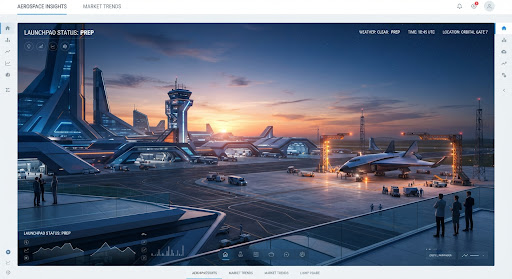
The number of active and licensed spaceports worldwide has more than doubled over the past decade, and the category has splintered into something far more varied than the classic government launch complex. As private aerospace entities push their operational cadence upward, commercial spaceports are emerging as a new global infrastructure standard — smaller in footprint than legacy ranges, faster in turnaround, and sited for market access rather than purely for downrange safety corridors. National infrastructure planners on at least four continents are now treating launch capacity the way an earlier generation treated deep-water ports and international airports: as strategic assets worth competing for.
Why Cadence Changes Everything
Legacy government launch ranges were built around a handful of missions per year, each treated as a bespoke campaign with weeks of pad occupancy and armies of range staff. Commercial operators are designing around cadence instead — some announced facilities target weekly or even more frequent operations, and that tempo fundamentally changes what the ground infrastructure has to be.
Propellant logistics are the clearest example. A pad supporting frequent launches cannot rely on occasional tanker convoys; it needs standing cryogenic storage, on-site or near-site propellant production, and the electrical supply to run it — which is why co-location with renewable generation keeps appearing in announced site plans. Static-fire test capacity has to be scheduled like a production line rather than an event, and range-safety systems have to clear airspace and waterways routinely enough that automation, not headcount, becomes the only economically viable approach.
The Emerging Commercial Spaceport Design Pattern
DCM Aeronautique’s infrastructure desk has tracked announced spaceport projects across four continents and finds a consistent architecture converging, largely independent of geography:
- Modular pad design, with vehicle-specific interfaces built as swappable elements so a single site can host multiple launch vehicle families
- Automated flight-termination and range-safety systems that cut per-launch staffing overhead by an order of magnitude relative to legacy ranges
- Horizontal-launch runways alongside vertical pads at some sites, hedging across suborbital, air-launch, and conventional orbital concepts
- Renewable power co-location to offset the substantial grid demand of propellant production and pad operations
The modularity point deserves emphasis, because it mirrors a broader shift in aerospace ground infrastructure thinking. A pad locked to one vehicle is a stranded asset the moment that vehicle’s manufacturer stumbles; a modular pad is a diversified one. Site developers have clearly absorbed that lesson, and it changes the financing conversation — a multi-tenant facility can underwrite construction against several operators’ manifests rather than betting on one.
The Regulatory Layer Is the Real Pacing Item
Every new spaceport is also a new node in an increasingly complex international coordination problem spanning airspace management, maritime exclusion zones, and orbital-slot deconfliction. Licensing frameworks in most jurisdictions were written for infrequent, government-led launches; adapting them to high-cadence commercial operations is proving slower than pouring concrete. The pattern is familiar from other frontier aviation sectors — in the eVTOL infrastructure race, too, the vehicles are arriving faster than the regulatory and ground ecosystem built to receive them.
Airspace Is a Shared Resource
A launch window typically closes airways and reroutes commercial traffic, and at legacy cadence that was a tolerable rarity. At weekly cadence from multiple sites, it becomes a structural air-traffic-management problem. Regulators are experimenting with dynamic, time-boxed closures rather than blanket hazard areas, but harmonizing those procedures across national boundaries remains unfinished work — and any future high-speed point-to-point ambitions, of the kind discussed in our coverage of hypersonic propulsion systems, will inherit whatever coordination framework the spaceport era establishes.
The realistic outlook is that regulatory throughput, more than any remaining engineering constraint, will set the pace of spaceport buildout over the next several years. The concrete, cryogenics, and automation are on the order of two-to-three-year construction projects; the licensing and airspace harmonization work is typically longer. The jurisdictions that streamline that layer first will not just host launches — they will define the operating standard everyone else adopts, much as a handful of early aviation authorities once wrote the rules the whole world now flies by.