
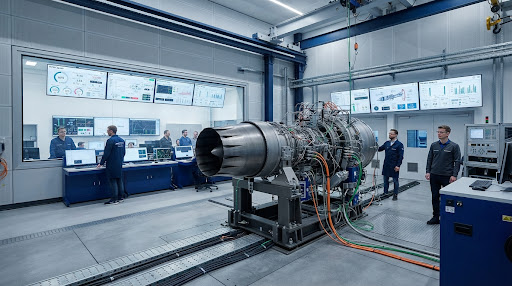
For six decades, the sound barrier has been a solved problem while the hypersonic threshold — Mach 5 and beyond — remained the domain of experimental military hardware. That is now changing. Recent breakthroughs in scramjet technology have moved hypersonic propulsion systems from wind-tunnel curiosity to a credible engineering roadmap for commercial travel, carrying with them the headline promise of transatlantic flight times under two hours. DCM Aeronautique’s propulsion desk has spent the past two quarters reviewing the publicly disclosed test data behind that shift, and the picture that emerges is of a technology crossing the line from “possible” to “certifiable.”
How Scramjet Propulsion Systems Work
Unlike a turbojet, a scramjet — a supersonic combustion ramjet — carries no rotating compressor stage at all. Incoming air is compressed by the vehicle’s own forward speed and by carefully shaped shock geometry along the inlet, after which fuel is injected directly into an airstream that is still moving supersonically. The entire combustion event lasts a matter of milliseconds, which is precisely why scramjet combustor design took half a century to mature: there is almost no dwell time in which to correct an unstable flame front. Mixing, ignition, and stable burning must be engineered to happen essentially instantaneously, every time.
The architecture carries an operational corollary that shapes the whole vehicle: a scramjet produces no thrust at a standstill. Any commercial hypersonic transport will therefore be a combined-cycle machine, using conventional turbine or rocket-assisted propulsion to reach the several-Mach speeds at which the scramjet can take over — an integration challenge that is, in many respects, as demanding as the combustor itself.
Materials, Not Aerodynamics, Changed the Game
What unlocked the current progress is materials science rather than aerodynamics. Ceramic matrix composite combustor liners now survive sustained exposure to gas-path temperatures that would have destroyed a nickel superalloy structure within seconds — the same class of thermal problem that shaped turbine-section engineering in conventional jet engines, pushed another regime hotter. Alongside the ceramics, additively manufactured fuel injectors have delivered far finer atomization control than machined injector blocks ever allowed, and that atomization quality translates directly into flame stability in a millisecond-scale combustion window.
The fuel itself is part of the thermal architecture. The specialized endothermic hydrocarbon fuels these engines favor absorb substantial heat as they crack chemically on the way to the injectors, letting the fuel serve as the engine’s coolant before it burns — an elegant closure of the thermal loop, but one that binds engine operability to fuel chemistry more tightly than in any conventional powerplant. As one internal technical review put it: “We are no longer asking whether a scramjet can sustain stable combustion above Mach 5 — we are asking how many flight hours we can certify it for. That is a fundamentally different, and far more tractable, engineering question.”
The Transatlantic Case
A hypersonic transport cruising near Mach 5 would cut London–New York flight time to well under two hours. The more interesting number for airline planners, however, is utilization: at that speed, a single airframe could realistically complete three to four transatlantic round trips per day, where a conventional widebody manages one. Aircraft utilization math of that kind changes fleet economics fundamentally, even before ticket pricing is considered — fewer airframes serving the same schedule, with capital cost spread across several times the revenue flights.
What Still Stands in the Way
The remaining obstacles are regulatory and infrastructural rather than purely technical:
- Sonic boom mitigation over populated corridors, which will likely confine early routes to overwater alignments
- Thermal-protection maintenance intervals — airline economics cannot absorb inspection-heavy turnarounds after every flight
- Fuel logistics, since endothermic hydrocarbon fuels demand airport-side production and handling infrastructure that does not yet exist at scale — a buildout challenge with clear parallels to the ground-infrastructure problem facing hydrogen propulsion
- A certification basis for sustained civil Mach 5 operations, which regulators are only beginning to sketch
None of these is trivial, but none is a physics problem — and that is the real meaning of the past few years of test results. The engineering community has largely closed the gap between “flies in a test cell” and “could fly in revenue service”; what remains is the slower, institutional work of certification, infrastructure, and route economics. Expect progress to be measured in published certification milestones rather than dramatic first flights, and expect the first commercial applications to look conservative: premium transoceanic routes, modest frequencies, and a fuel and maintenance ecosystem built out one airport at a time.