
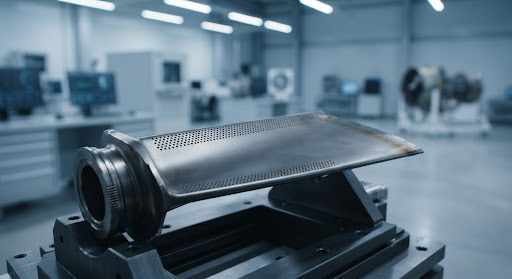
Modern jet engine technology represents the pinnacle of contemporary engineering, and nowhere is that clearer than in the high-pressure turbine, where precision engineering in modern jet engines confronts an apparent impossibility: the thermodynamic stresses placed upon internal components exceed the melting points of the very alloys from which they are constructed. The paradox is resolved through advanced metallurgy, intricate cooling geometries, and manufacturing tolerances measured in microns — three disciplines that only succeed because they are engineered together.
The environment is difficult to overstate. Gas leaving the combustor is far hotter than the solidus temperature of nickel superalloys, and stage-one blades sit in that stream while spinning fast enough to generate centrifugal loads on the order of tens of tonnes per airfoil. Every design decision downstream flows from surviving that combination for thousands of hours at a time.
Thermal Barrier Coatings: The First Line of Defense
Thermal barrier coatings act as the first line of defense. These ceramic layers, typically based on yttria-stabilized zirconia, are applied using electron beam physical vapor deposition, a process that grows the coating as a field of fine columns rather than a monolithic sheet. That columnar microstructure is the entire point: it allows the coating to expand and contract with the metal substrate through extreme thermal cycling without delaminating — flexing like a brush rather than cracking like a tile.
“The challenge isn’t just surviving the heat; it’s maintaining the precise aerodynamic profile of the blade while it’s spinning at 15,000 RPM in a 1,600°C environment,” as a lead engineer at DCM Propulsion Labs put it during our reporting. Coating thickness is itself an aerodynamic variable — apply too much and the airfoil shape drifts away from design intent.
The Complexity of Internal Cooling
Inside every high-pressure turbine blade is a labyrinth of cooling passages. Air bled from the compressor is routed through serpentine channels, over turbulence-promoting ribs and pin-fin arrays, before exiting through thousands of laser-drilled film cooling holes. The result is a thin skin of cooler air that separates the blade surface from the white-hot combustion gases streaming past it.
Manufacturing that labyrinth is its own discipline. The internal geometry is formed by ceramic cores during single-crystal investment casting, and each film cooling hole must be drilled at a precise compound angle so the emerging air lays down along the surface rather than jetting into the gas stream. A mis-angled hole can be worse than a missing one — it may trip the boundary layer and locally increase heat load.
There is also a thermodynamic price. Every kilogram of compressor air diverted to cooling is air that did no combustion work, so cooling flow is budgeted as carefully as weight. Designers speak of buying blade life with cycle efficiency, and cooling design is the art of spending as little of that budget as possible.
Precision Engineering at the Micron Scale
The materials themselves operate near their limits. Typical stage-one blade alloys deliver figures on the order of:
- Tensile strength: approximately 1,240 MPa
- Operating ceiling: around 1,150°C for the base alloy, before film cooling and coatings extend it
- Creep resistance: ultra-high, achieved through single-crystal solidification that eliminates grain boundaries entirely
Tolerances are correspondingly severe. The maximum permissible deviation for trailing-edge geometry on stage-one turbine assemblies is ±0.002 mm — a bound that shapes the entire manufacturing chain, from the machine-tool thermal management explored in our coverage of multi-axis machining for turbine components to final inspection, where optical and coordinate metrology verify every airfoil against its nominal model before it is ever mounted to a disk.
As the industry moves toward the next generation of propulsion — Open Fan architectures and hybrid-electric cores — these precision requirements will only intensify: larger, slower fans place new demands on turbine spool efficiency, and every efficiency point is won or lost at the blade surface. Operators, meanwhile, are watching these same components age in service through the condition-monitoring approaches covered in our review of predictive digital twins for fleet reliability. DCM Aeronautique’s editorial desk will keep documenting the intersection of physics and fabrication with the rigor it demands.