
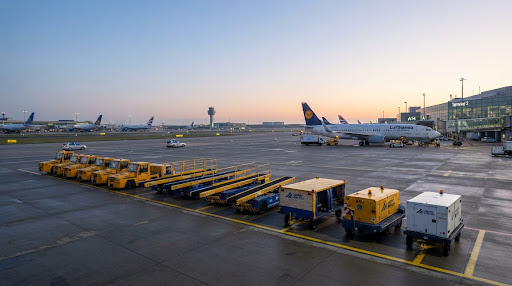
Ground vehicle fleets rarely get the predictive maintenance attention lavished on the aircraft they service, despite the fact that a failed tug on the ramp during a tight turnaround can cascade into gate delays just as costly as a mechanical issue on the airframe itself. Predictive maintenance for tug fleets is now becoming practical because IoT retrofit sensor kits — tracking hydraulic pressure, engine health, and battery condition in real time — have made fleet-wide condition monitoring economically viable for equipment that was never designed with telemetry in mind.
The economics of the problem are asymmetric in a way that favors early detection. A tug is a modest capital asset, but the turnaround it anchors is not: a pushback tractor that dies under an aircraft at a peak-bank departure slot can ripple through a hub’s schedule for hours. Catching that failure days earlier, while the vehicle is parked between shifts, converts an operational crisis into a routine work order.
What a Retrofit Sensor Package Actually Monitors
A typical kit is deliberately simple — a handful of transducers, a vibration pickup, and a cellular or Wi-Fi gateway bolted onto a vehicle that may be decades old. The parameters that matter most on the apron are:
- Hydraulic system pressure and temperature, where slow drift is the classic precursor to seal and pump failure
- Engine or drive-motor vibration signature, which shifts measurably as bearings and mounts degrade
- Battery state of health on electric units, tracked per-cell where the platform allows it
- Brake wear and actuation timing, a safety-critical item on any vehicle rated to move loaded airframes
The value is not in any single reading but in the trend line. Checked at a scheduled interval, a hydraulic system either passes or fails; streamed continuously, the same system reveals a pressure-drift curve weeks before it crosses a failure threshold. DCM Aeronautique’s ground operations correspondents have reviewed deployment data from several major hub ramps showing hydraulic failures — historically among the most common causes of unscheduled tug downtime — caught at the drift stage rather than the catastrophic stage, giving planners days rather than minutes of lead time.
Why the Business Case Closes at Hub Airports First
The retrofit cost per vehicle is modest relative to the cost of a single stranded-equipment delay during peak operations, which explains the adoption pattern: uptake has moved fastest at exactly the hub airports with the least schedule slack to absorb ramp equipment failures. An outstation with generous turn times can tolerate a dead tug; a slot-constrained hub cannot.
The data pipeline itself is refreshingly unexotic. Most kits ride existing cellular networks or airport Wi-Fi rather than requiring dedicated buildout, and the analytics workload is small enough to run on commodity cloud infrastructure. This is one corner of aviation where the hard part is not the technology but the discipline — keeping sensors calibrated, keeping maintenance teams acting on alerts rather than muting them, and integrating findings into the existing work-order system rather than a parallel dashboard nobody opens.
The Electrification Overlap
There is a timing advantage in the current fleet-replacement wave. As ramps transition to battery-electric ground support equipment, the new vehicles arrive with native telemetry — battery management systems already stream exactly the health data retrofit kits struggle to approximate. Operators standing up monitoring programs now are effectively building the organizational muscle their next-generation fleet will assume by default.
From Vehicle Health to Fleet Intelligence
The next phase under evaluation is cross-fleet pattern analysis: aggregating sensor data across an entire tug and loader fleet to identify systemic wear patterns tied to specific duty cycles, routes across the apron, or maintenance intervals, rather than treating each vehicle’s health in isolation. Conceptually this is the same trajectory aircraft engines have followed with predictive digital twin analytics — individual asset monitoring maturing into fleet-level modeling that feeds back into procurement and scheduling decisions.
Ground support has always been the unglamorous end of airside operations, but the gap between how aircraft and the vehicles that serve them are maintained is closing quickly. Within a few equipment generations, a tug without a live health feed will look as anachronistic on a major ramp as an aircraft without one does today.