
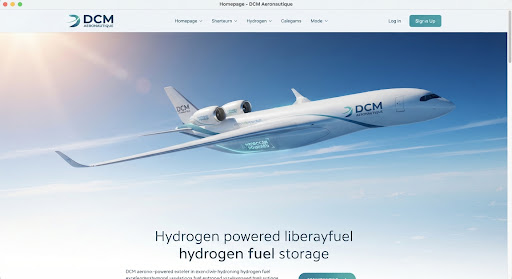
Hydrogen combustion and hydrogen fuel-cell propulsion are frequently discussed as a single technology category, but from an airframe engineering standpoint they present almost entirely different structural challenges. Both, however, share one foundational problem — liquid hydrogen must be stored at roughly -253°C — and that cryogenic requirement drives nearly every difficult decision on the hydrogen propulsion roadmap between now and 2030. For this piece, DCM Aeronautique’s editorial desk spoke with propulsion engineers working the problem daily, and their message was consistent: the hard part is not burning hydrogen, it is carrying it.
The two architectures diverge from there. Combustion routes hydrogen to modified turbine combustors and largely preserves today’s propulsion layout; fuel cells convert it to electricity for motor-driven propulsors and bring a substantial heat-rejection problem of their own. What they share is the tank.
The Tank Is the Airframe Problem
Liquid hydrogen’s low volumetric energy density — even in cryogenic liquid form, it occupies roughly four times the volume of an energy-equivalent quantity of jet fuel — means tankage cannot simply be tucked into existing wing structure the way conventional fuel is. Wings are thin, and cryogenic tanks want to be cylindrical or spherical to carry pressure loads efficiently. Most credible hydrogen aircraft concepts under review therefore relocate fuel storage to the fuselage, typically aft of the cabin.
That relocation cascades through the whole design. Center-of-gravity management changes as fuel burns off from a fuselage tank rather than distributed wing cells; cabin length is traded directly against tank volume; and the structure around the tank must be engineered for crashworthiness in ways kerosene systems never demanded. Ground servicing choreography changes too, since refueling connections, venting paths, and safety zones all move with the tank.
Insulation, Boil-Off, and the Weight Budget
Insulation is the other structural driver. A cryogenic tank wall is not a single skin but a multi-layer sandwich structure — typically combining foam or vacuum insulation layers with vapor barriers — engineered to minimize boil-off across a full flight duration plus realistic ground hold times. Every gram of insulation is a gram not available for payload, a tension propulsion engineers describe as the central design trade of the entire hydrogen aircraft concept.
Boil-off management is as much operational as structural: some venting is unavoidable, so turnaround procedures, hold-time limits, and vent-gas handling all become part of the design case. Meanwhile, whether the tank should carry airframe loads or hang suspended within conventional structure remains genuinely unsettled among the teams working the problem — a sign of how young this design space still is.
What a Realistic Hydrogen Roadmap Looks Like
“The propulsion engineering is largely understood. What is not yet solved is airport-side hydrogen production, storage, and refueling infrastructure at commercial scale — and that is a decade-long buildout, not a two-year one,” one lead propulsion engineer told DCM Aeronautique in our interviews for this piece.
That caveat deserves emphasis, because infrastructure is where aviation’s hydrogen timeline will actually be set. Liquefaction plants, cryogenic distribution, and gate-side refueling represent capital programs comparable in kind to the airport electrification work we examined in our review of next-generation electric ground support — but larger still in scale. Airports face the same pattern seen across the eVTOL infrastructure race: vehicles maturing faster than the ground ecosystem that must support them.
The plausible sequence, in the engineering assessments we have reviewed, runs roughly as follows:
- Demonstrators and certification groundwork through the late 2020s, retiring tank, fuel-system, and safety-case unknowns.
- Regional turboprop-class hydrogen aircraft as the first commercial entry point, since shorter ranges keep the tank volume penalty manageable.
- Selected hydrogen-ready airport corridors, concentrating infrastructure investment on a few city pairs rather than whole networks.
- Mainline narrow-body hydrogen service as a 2035-and-beyond proposition, contingent on ground infrastructure that does not yet exist at scale.
None of this makes hydrogen aviation a mirage; it makes it a program measured in infrastructure decades rather than product cycles. The airframes will very likely be ready when the airports are — and the engineering community’s quiet confidence in the first half of that sentence is exactly why the second half now deserves the industry’s full attention.