
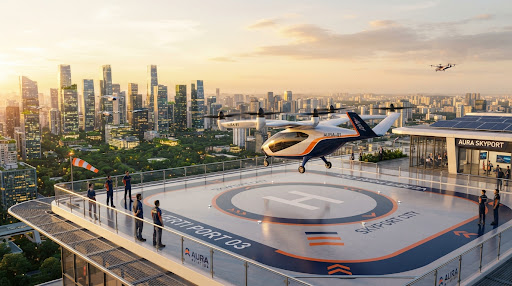
The regulatory framework for eVTOL aircraft is evolving quickly, and the aircraft themselves have cleared most of their technical hurdles — distributed electric propulsion, redundant fly-by-wire flight control, and battery energy density have all matured to the point where several manufacturers hold conforming type-certification bases with civil aviation authorities. That leaves the defining contest of urban air mobility’s first commercial decade happening on the ground: the eVTOL infrastructure race, in which vertiports, charging capacity, and airspace corridors must be built out fast enough to give certified aircraft somewhere useful to fly.
It is a race the airframes are currently winning by an uncomfortable margin.
The Vertiport Problem: eVTOL Infrastructure Beyond the Landing Pad
A commercial eVTOL network needs far more than a painted pad on a rooftop. Each vertiport requires high-rate DC fast-charging infrastructure sized for simultaneous multi-aircraft turnarounds, dedicated approach and departure paths deconflicted from existing rotorcraft and drone traffic, and passenger handling that keeps boarding closer to a train platform than an airport terminal — the entire commercial premise collapses if a twelve-minute flight carries forty minutes of ground process on each end.
The most stubborn constraint, however, is electrical. Charging several aircraft at once concentrates a demand peak that most dense urban cores were never designed to deliver at a single point of connection, and grid interconnection upgrades in a city center move at utility pace, measured in years. A review of announced vertiport programs across North America and Europe shows a consistent pattern: the aircraft are arriving faster than the ground infrastructure, and several operators have quietly shifted their initial commercial routes to airport-adjacent sites specifically because urban rooftop vertiports remain snarled in zoning and grid-interconnection approvals. Airports, notably, are already fighting the same concentrated-demand battle as they electrify their ramps — the apron upgrades underway for battery-electric ground support fleets are, in effect, a rehearsal for vertiport power provisioning.
Airspace Integration by Corridor
On the airspace side, regulators are converging on a corridor-based architecture rather than free-form urban flight, borrowing structure from established helicopter routes. Aircraft will fly published, repeatable tracks with defined altitudes and handoff points instead of picking point-to-point paths across a city.
This is a pragmatic compromise. It sacrifices some of the go-anywhere flexibility that made urban air mobility commercially seductive in early pitch decks, but it dramatically simplifies deconfliction with existing air traffic — and it makes community noise exposure predictable, which matters enormously for public consultation. A corridor with a known, modeled noise footprint is something a city council can approve; a promise that quiet aircraft will be “somewhere overhead” is not. Expect corridor structures to loosen only gradually, as operational data accumulates and detect-and-avoid tooling matures.
Financing the Critical Path
The remaining problem is money, and it is less tractable than it sounds. Vertiports sit awkwardly between infrastructure categories — too aviation-specific for conventional real estate capital, too small and unproven for the airport-finance playbook — and their revenue depends on a network that cannot exist until several of them are built. That circularity, more than any engineering question, now sets the program tempo.
“The airframes are ready years ahead of the ecosystem that has to support them. Infrastructure financing, not battery chemistry, is now the critical path for urban air mobility.” — DCM Aeronautique Infrastructure Review
The early capital is accordingly coming from parties with adjacent assets to leverage: airport authorities extending existing landside infrastructure, heliport operators upgrading sites that already hold aviation approvals, and parking-structure owners converting rooftop levels where grid access can be negotiated. It is a patchwork, but a rational one — each of those paths shortcuts a permitting fight that a greenfield urban site would face in full.
Put together, the realistic picture for 2030 is narrower than the renderings but genuinely operational: the first sustained commercial UAM corridors connecting airports to downtown cores, flown at modest frequency along fixed tracks, rather than the fully distributed city-wide mesh originally envisioned. That is a more conservative target — and a considerably more achievable one. The networks that master those first corridors, and the infrastructure economics underneath them, will be the ones positioned to expand when the grid, the regulators, and the financing finally catch up to the aircraft.